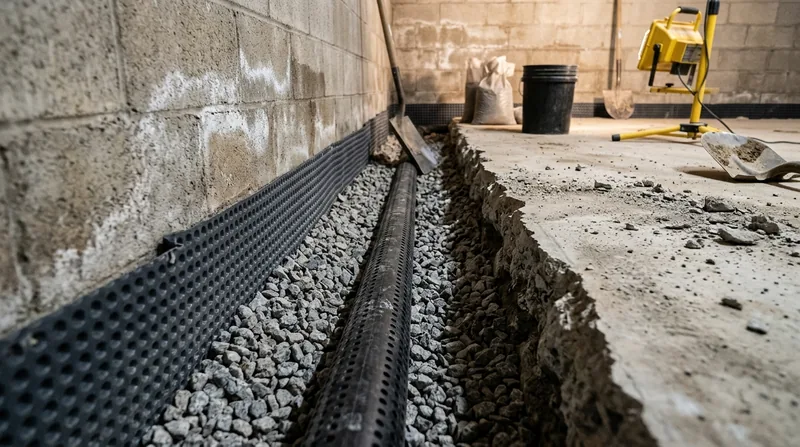




If you live in one of Rochester's older neighborhoods like Lowertown or the east-side streets, you already know the pattern: spring thaw saturates the glacial clay till, the water table rises, and by April your basement floor is weeping. The same thing happens in Elton Hills ranches and Pill Hill split-levels, where 1950s block walls have been through sixty freeze-thaw cycles. An Interior Drain Tile System in Rochester is the proven fix for this ground: we cut a channel along the inside of the footing, capture water before it reaches the slab, and route it to a sump basin that pumps it out. No exterior excavation, no torn-up yard, and it works in any season. If you want the broader picture of how this fits with wall sealing and vapor control, start with our basement waterproofing service.
Why Interior Drain Tile Matters in Rochester's Glacial Till and Fractured Limestone
Rochester sits on glacial till over fractured Galena limestone. That bedrock is cracked and karst-like, so groundwater finds joints, springs, and sinkholes instead of draining evenly. The clay-rich till above it holds snowmelt like a sponge, and when the Zumbro River and Cascade Creek run high after a heavy summer storm, runoff pools in low yards and pushes against your foundation. That is hydrostatic pressure, and it does not care how many times you patch the inside of the wall.
- Water enters through the cold joint where the wall meets the footing, which is exactly where an interior perimeter drain captures it.
- Block and stone walls in pre-1940s houses wick water upward and show efflorescence, a white salt bloom that tells you moisture is moving through the masonry.
- Poured concrete basements in Northwest Rochester subdivisions crack at shrinkage points and let water in at the cove joint during spring thaw.
- Original weeping tile from the 1950s and 1960s is often collapsed or silted shut, so the footing drain no longer carries water away.
When the ground is saturated and the original drain tile is dead, an interior system is the reliable answer. Simple crack sealing is enough for a single static crack, but it will not hold back a rising water table.
Key info: A homeowner in the older east-side streets called us after every spring thaw because water ran across the basement floor from the cove joint. The original 1930s footing drain was clay tile packed solid with silt. We installed an interior perimeter drain and a new sump basin, and the floor has stayed dry through three snowmelts.
For official guidance on basement moisture and structural repairs, the City of Rochester's building department is the authority to check before any work begins: City of Rochester, MN.
How We Install an Interior Drain Tile System in Rochester Homes
We start by walking the basement and reading the water. Where is the efflorescence? Where is the floor stained? Does the sump pit fill during a rain, or does it stay dry until the water table rises in March? That tells us whether the problem is a single crack or a full perimeter issue. Then we lay out the drain line along the footing, set the sump basin at the low point, and plan the discharge so it leaves the house above grade and away from the foundation.
- We break and remove a strip of slab, roughly 12 to 16 inches wide, along the inside of the footing.
- We dig down to the footing and clean out the old drain tile or silted gravel.
- We set a perforated drain tile in washed gravel with a filter fabric sock to keep glacial clay out.
- We install the sump basin, plumb the drain line into it, and fit a check valve on the discharge.
- We pour a new concrete patch over the channel, flush with the existing floor, and tie the wall base into the system with dimple board where needed.
The whole job stays below grade and inside the house, so your yard, driveway, and landscaping stay untouched. It works in January as well as July.
Key info: A split-level in Bamber Valley had a finished basement with carpet and a wet bar. We cut the perimeter channel, kept the sump basin in the mechanical corner, and patched the floor so the carpet went back down over a dry slab. The discharge line ran to a dry well 12 feet off the foundation, not onto the neighbor's grade.
If your sump pump is the weak link, pair the new drain with a battery backup sump pump so a power outage during a summer storm does not flood the basement.
Interior Drain Tile Approaches: Which One Fits Your Rochester Basement
Not every basement needs the same system. A 1920s stone-wall basement in Lowertown behaves differently from a 2015 poured-wall walkout on the southeast edge. The table below shows the main approaches we use and where each one fits.
| Approach | Description | Best for |
|---|---|---|
| Full interior perimeter drain | Perforated tile along the entire footing, gravel bed, sump basin, discharge line. | Wet floors along more than one wall, rising water table, failed original drain tile. |
| Partial perimeter drain | Drain tile along the wet walls only, tied into a single sump basin. | One or two wet walls, budget-conscious jobs, older homes with dry interior walls. |
| Drain tile plus dimple board | Perimeter drain combined with dimple board on the wall base to relieve seepage above the footing. | Block and stone walls with efflorescence and damp masonry. |
| Drain tile with new sump and backup | Full perimeter drain, new sump basin, primary pump, and battery backup. | Finished basements, walkouts, homes that lose power in summer storms. |
| Drain tile repair only | Replace a failed section of existing interior drain and reconnect to the sump. | A system that was installed correctly but has silted or collapsed in one run. |
Interior Drain Tile System Cost in Rochester: What to Expect
Pricing for an interior drain tile system starts at about $50 per linear foot, and that figure covers the channel, the perforated tile, the gravel, and the concrete patch. The variables that move the number are the length of the run, whether the basement is finished, how deep the footing sits, and whether the job needs a new sump basin and pump. A single-wall partial drain in a 1950s ranch is a different job from a full perimeter in a 3,000-square-foot walkout.
Getting two or three estimates is smart, not suspicious. Ask each contractor what happens to the old drain tile, how they handle the discharge, and whether the price includes the sump basin and pump or treats them as extras. A low bid that leaves you buying the pump separately is not a low bid. You can see how we break down line items on our pricing page.
If the water is coming through a specific crack rather than the cove joint, foundation crack repair with epoxy or polyurethane injection may solve it for far less than a full drain. We will tell you plainly when that is the case.
Choosing a Waterproofing Contractor Near Rochester: What to Check
Basement waterproofing is a below-grade trade, and the contractor you hire should be licensed and insured for that work, not a general handyman with a jackhammer. Ask for the certificate of insurance before work starts, and confirm the policy covers both general liability and workers' compensation. Then get at least two written estimates that spell out the scope: linear feet, sump basin, pump, discharge route, and concrete patch.
Ask for references from jobs in Rochester or the surrounding towns like Byron, Stewartville, or Kasson, and call one. Ask whether the crew pulled the right permit if the work alters drainage or the sump discharge connection, because rules vary by jurisdiction and the local building department has the final word. If you are in an HOA, check the rules on discharge lines and exterior grading before the crew arrives. Our contact page is the place to start a free inspection.
One more thing: a contractor who promises a lifetime warranty on the whole system is telling you something. A transferable warranty on the workmanship is normal and worth having, but read the terms and know what is covered.
Interior Drain Tile System Near Me: When to Call in Rochester
If you are searching for an interior drain tile system near me in Rochester, the trigger is usually one of three things: water on the floor after every rain, a sump pit that fills faster than the pump can move it, or a musty smell that comes back every spring. Those are signs the water is already under the slab and the original footing drain has quit. Call (507) 516-5528 and we will schedule a free basement inspection, no obligation.
Interior Drain Tile System in Rochester: Pricing Guide
| Service | Price | Details |
|---|---|---|
| Partial interior perimeter drain | Starting at $50/linear ft | Covers channel, perforated tile, gravel, and concrete patch along the wet walls only |
| Full interior perimeter drain | Starting at $50/linear ft | Full footing run with sump basin tie-in, price rises with linear feet and finished basement access |
| Drain tile plus sump and backup | On estimate | Full perimeter drain with new sump basin, primary pump, and battery backup quoted after on-site look |
| Drain tile repair only | On estimate | Replacing a failed section of existing interior drain and reconnecting to the sump, scoped on site |
| Travel | Included | In Rochester and surrounding areas, no separate call-out or mileage fee |
| Estimate | Free | Response within 24h at (507) 516-5528, no obligation to book |
Indicative pricing, the exact cost depends on square footage, finish, and site access. Free personalized estimate within 24h at (507) 516-5528.


