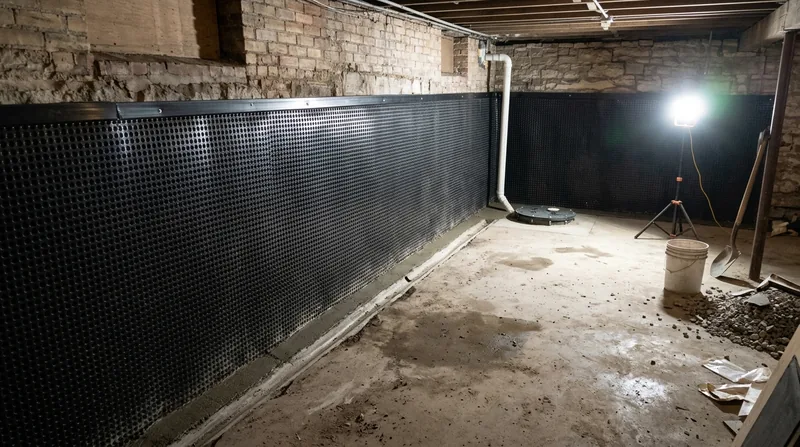




If you have water in the basement after a spring thaw or a heavy Zumbro River storm, Basement Waterproofing in Rochester starts with finding the actual path the water takes, not with a tube of caulk. Much of this city sits on glacial till over fractured Galena limestone, so groundwater moves through joints, springs, and karst seams instead of soaking in evenly. The older brick and stone basements in Lowertown and the east-side streets seep through mortar joints, while the poured walls in the Northwest Rochester subdivisions usually leak at the floor joint and tie holes. We trace that path, then build a system sized for it: interior drain tile, a correctly sized sump basin, wall treatment, and a vapor barrier. If you want the full picture of how we approach below-grade work, start with our Rochester Waterproofing homepage.
Why Water Finds Rochester Basements: Glacial Clay, Limestone Joints, and Freeze-Thaw
The ground here holds water the way a cracked plate holds a spill. Clay-rich till sits on top of fractured limestone, so snowmelt and summer storm runoff cannot drain down evenly and instead press sideways against foundation walls. Long winters drive freeze-thaw cycles that open block and stone walls a little wider every year, and the water table rises fast after a heavy rain. That is why a wet basement in Elton Hills and a wet basement in a 2010s build on the southeast edge can look identical at the floor joint but need different fixes.
- Hydrostatic pressure pushes water through hairline cracks, mortar joints, and the cove where the wall meets the floor.
- Glacial clay soil holds snowmelt for weeks, so seepage often shows up in March and April, not during the storm itself.
- Fractured limestone and karst seams let groundwater rise in places that look dry on the surface.
- Freeze-thaw cycles widen existing block and stone cracks through the long northern winter.
- Clogged or collapsed footing drains send roof and grade water back toward the wall instead of away from it.
Each of these failure modes points to a different repair, and guessing wrong is how homeowners end up paying twice.
Key info: A 1920s Lowertown house with a stone foundation and a 1990s walkout in Bamber Valley rarely fail the same way. The stone wall wicks water through mortar, while the poured wall leaks at the floor joint and form ties. We inspect the wall type and the floor joint before quoting anything.
Permits for structural foundation repair and for work that alters drainage or the sanitary connection of a sump discharge vary by jurisdiction. Always confirm requirements with the local building department before work begins. You can review Minnesota contractor resources through the Minnesota Department of Labor and Industry.
How We Work: Tracing the Water Path Before We Cut a Floor
We start with a free basement inspection that looks at the wall type, the floor joint, efflorescence patterns, the sump basin, the discharge line, and the grading outside. Then we run water where we can and watch where it appears. Only after that do we recommend a scope, and we tell you plainly when simple crack sealing is enough and when the real problem is hydrostatic pressure that no surface sealer will hold back. If the water is rising at the floor joint across a long run of wall, an interior drain tile system is usually the better answer than exterior excavation.
- We inspect the basement, the wall cracks, the floor joint, and the exterior grade and downspout extensions.
- We identify whether the source is wall seepage, floor joint rise, a failed footing drain, or a sump pump that cannot keep up.
- We recommend the smallest system that solves the problem, from crack injection to a full interior perimeter drain.
- We install the drain tile, sump basin, pump, check valve, and discharge line, then test the system with water.
- We seal walls, install a vapor barrier where needed, and walk you through the finished work.
You get a written scope and a clear explanation of what each part does, so you can compare bids on equal terms.
Key info: In a 1960s split-level in Pill Hill, the owner had already sealed the wall twice and still had water after every storm. The actual source was a collapsed footing drain on the uphill side. We replaced the drain run and tied it to a new sump basin instead of selling another coat of sealer.
If the inspection shows a failed drain line rather than a wall problem, we move to drain tile repair and replacement and keep the rest of the system intact.
Waterproofing Methods We Use and When Each One Fits
No single method covers every Rochester basement. The table below shows the approaches we use most and the conditions each one is built for, so you can see where your situation lands before we ever quote a number.
| Approach | Description | Best for |
|---|---|---|
| Interior perimeter drain | Drain tile cut along the floor joint leading to a sump basin and pump | Water rising at the floor joint across long wall runs |
| Epoxy or polyurethane injection | Ports set into a crack and resin injected under pressure | Isolated poured-wall cracks with no floor joint rise |
| Exterior membrane and dimple board | Waterproof membrane, protection board, and footing drain at the exterior wall | Walls being excavated anyway or severe clay pressure |
| Wall sealing and vapor barrier | Surface sealing, parging repair, and a vapor barrier on the interior wall | Damp walls and efflorescence without active flow |
| Sump pump and battery backup | Primary pump, check valve, discharge line, and battery backup unit | Storm-driven inflow and power outages |
We match the method to the evidence, not to a sales target, and we tell you when a cheaper fix will hold.
Basement Waterproofing Cost in Rochester: What to Expect
Most basement waterproofing projects in Rochester start at From $2,500, and that figure usually covers a focused scope such as crack injection or a partial drain run with a sump upgrade. A full interior perimeter drain with a new basin, pump, and discharge line runs higher because of the labor, the concrete cutting, and the length of wall involved. Exterior excavation is the most expensive path and is only worth it when the wall itself needs work or the clay pressure is severe. We give you a written scope so you can compare bids line by line instead of guessing at a lump sum.
Several factors move the number: the length of wall involved, whether the wall is stone, block, or poured concrete, the depth of the frost line and footing, access for equipment, whether the discharge line can daylight to grade, and whether a bowing wall needs carbon fiber straps or wall anchors. A house in Stewartville with a short crack and a house in Oronoco with a spring-fed floor joint are not the same job. Getting two or three estimates is smart, and any contractor who quotes a full system without inspecting the wall is guessing. Our full pricing overview breaks down the ranges.
Choosing a Basement Waterproofing Contractor Near Me in Rochester
Start with licensed and insured status and ask for the certificate, not just a verbal yes. Ask how the contractor diagnoses the source, whether they will put the scope in writing, and whether they test the sump pump and discharge line before they leave. Check references from homes with the same wall type as yours, because a stone foundation and a poured wall fail differently. Confirm who pulls any permit the local building department requires for structural repair or drainage changes, and check any HOA rules before exterior work begins. If you want a straight answer on your own basement, contact us for a free estimate.
We are a dedicated basement waterproofing specialist, not a general foundation firm or a plumber, and we will tell you when a simple repair is the honest answer.
Basement Waterproofing in Rochester: Pricing Guide
| Service | Price | Details |
|---|---|---|
| Crack injection (epoxy or polyurethane) | Starting at $2,500 | Covers port setup, resin injection, and cleanup on isolated poured-wall cracks, priced by crack length and count |
| Interior drain tile with sump basin | Starting at $4,500 | Perimeter drain cut at the floor joint, new basin, pump, check valve, and discharge line to grade |
| Exterior waterproofing with membrane | On estimate | Excavation depth, wall length, footing drain condition, and access all need an on-site look before pricing |
| Sump pump replacement and battery backup | Starting at $1,200 | Primary pump swap, check valve, discharge line check, and battery backup unit sized to the basin |
| Travel | Included | In Rochester and surrounding areas, no separate call-out or mileage fee |
| Estimate | Free | Response within 24h at (507) 516-5528, no obligation to book |
Indicative pricing, the exact cost depends on square footage, finish, and site access. Free personalized estimate within 24h at (507) 516-5528.


